
Theme: The Weight They Carry
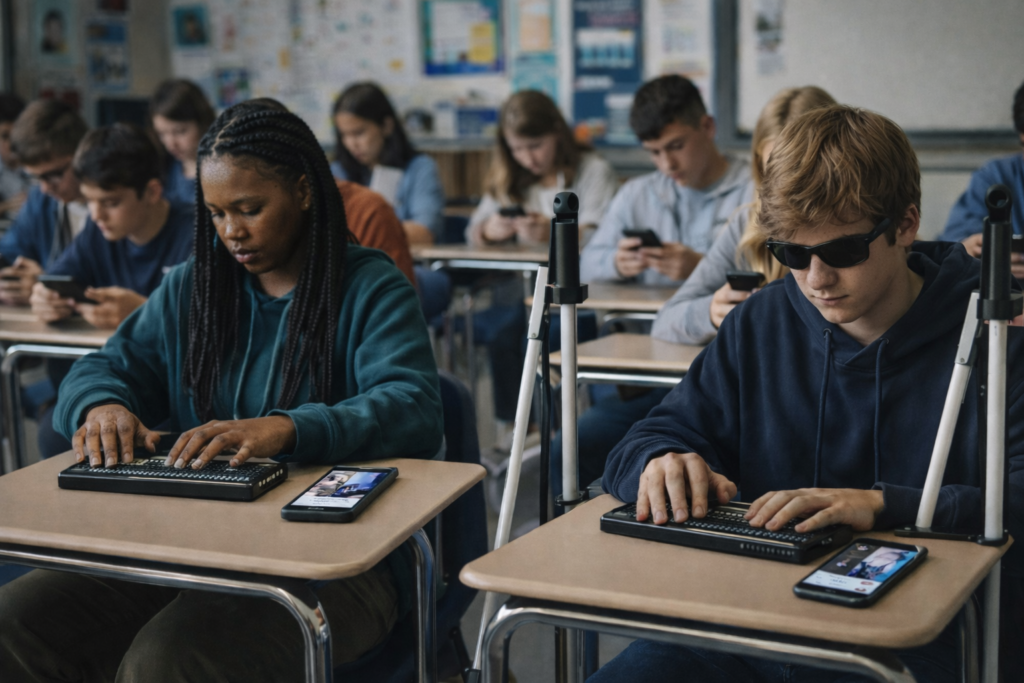
The Silent Exhaustion Teens Carry Into the Classroom
Screens glowed.
Thumbs moved fast.
Notifications flashed like sparks.
Someone laughed at a meme.
Someone posted a photo, then deleted it minutes later, afraid of judgment.
Ms. Sage felt concern rise in her chest.
The Hidden Weight Social Media Places on Today’s Teens
She had taught for thirty-two years.
This generation was not worse, just heavier.
National data shows 57% of teen girls and 29% of teen boys feel persistent sadness.
Teens who use social media more than three hours a day face double the risk of anxiety and depression.
She saw that weight in their faces.
Tired.
Anxious.
Disconnected.
Fragile.
“Phones away,” she said. “All the way away.”
Groans rose, but they obeyed.
She placed a cardboard box on her desk.
Plain. Unremarkable.
Important.
“Write down one truth you think while scrolling,” she said.
“No names. No jokes.”
She turned to her blind students.
“Suzy and John, you can text your message. I’ll copy it on paper so it stays anonymous.”
Pens moved.
Silence settled.
When Comparison Becomes a Daily Battle for Teens
Lila, the cheerleader with the perfect Instagram feed, stared at her blank paper.
She felt constant pressure to look flawless.
She spent eight hours a day comparing herself to strangers online.
National surveys echo her struggle.
Almost half of teens say social media makes them feel worse about their bodies.
One in three teen girls say it makes them feel “ugly.”
Scrolling created a false world where everyone else looked happier.
She finally began to write.
Jordan, the class clown with 12,000 followers, tapped his pencil.
He made people laugh but felt empty inside.
Teens who build perfect online personas are three times more likely to feel lonely.
His parents had split.
His mom worked two jobs.
Most nights, he ate alone.
He scrolled through happy posts and believed he was falling behind.
He posted jokes to hide the ache.
In the front row, Suzy and John felt invisible.
Being blind already set them apart.
Social media sharpened that feeling.
Picture-reading apps spoke image after image, yet they rarely found blind role models.
They searched for people who lived like them but found few.
The absence deepened their loneliness.
Most students in the room were like Joe and Sue — quiet, overlooked, and pushed aside.
They blended in.
They were teased for clothes, hobbies, and differences.
Invisibility hurt more than insults.
Brilliance with Hidden Pressure
Jessica and James stood out for a different reason.
They focused on academics, not trends.
They used social media less and felt healthier because of it.
Yet they carried pressure from home and fear of falling short.
Their drive isolated them too.
Tyler, the star running back, spun his pen.
Everyone assumed he had it together.
He did not.
Athletes struggle quietly as often as anyone else.
His parents had split.
His house was empty most nights.
He ate alone and scrolled through athletes who seemed stronger and happier and compared their victories with his fears.
He began to write too.
The Truth Teens Admit Only When They Feel Safe
Students dropped their slips in the box.
Silence filled the room.
Ms. Sage opened the first note.
“I feel invisible unless someone likes my posts.”
Another:
“I delete every picture. I hate how I look.”
Another:
“I check my phone 200 times because I’m scared people will forget me.”
Another:
“I pretend I’m confident. I’m not.”
Then the one that tightened her throat:
“I don’t want to be here anymore. Everyone else looks happy, and I feel lost and alone.”
CDC reports 22% of teens have seriously considered suicide.
Reading it in a child’s handwriting broke her.
Breaking the Lies Teens Carry
“This is what you’re holding,” she said softly.
“This heavy, invisible weight.
And you need to know… you are not the only one.”
Her voice steadied.
“You’re not strange for feeling overwhelmed or weak for aching.
You’re human.
And you’re not alone.”
Many wiped their eyes.
Letting Go of the Lies
Ms. Sage lifted the box and looked at the class.
“Come with me,” she said. “Bring your coats.”
They followed her down the hallway, through the back doors, and into the cold morning air.
The winter wind stung their cheeks.
Their breath rose in small clouds.
Behind the building, near the maintenance shed, stood Mr. Alden, the school’s longtime janitor.
He waited beside a metal burn barrel, flames crackling inside, andnodded when he saw her.
He had started the fire earlier, just as she asked.
“This,” she said, holding the box close, “is where we let go of what you were never meant to carry alone.”
She opened the box.
The folded slips rustled.
Then she tipped the box slowly, letting the papers drift into the flames.
Fire curled the edges.
Lies burned away.
Students stepped closer.
The girls began to cry.
The guys blinked hard and stuffed their hands in their pockets.
Suzy pressed her forehead to her cane and rocked gently.
John held his cane so tightly his knuckles went white.
Tyler stepped forward first.
He raised his hand over the barrel and waved goodbye to the weight he carried.
Another hand rose beside him.
And another.
Soon, every student lifted a hand toward the fire, each wave a quiet release of the lies that haunted them.
No one spoke.
No one joked.
They stood together in the winter air, letting the heat warm their faces and the truth settle in their hearts.
When the last ember faded, Ms. Sage spoke again.
“You don’t walk alone,” she said softly.
“And the lies you waved goodbye to are gone.
You don’t have to carry them anymore.”
Learning to Use Social Media Without Losing Yourself
Social media is part of modern life.
The goal is healthier habits.
Follow accounts that lift the spirit.
Mute the ones that create comparison.
Set time limits.
Build real friendships with real conversations.
Look up.
Notice the people who need connection too.
Faith Reflection: The God Who Sees the Overwhelmed and Brokenhearted
When everyone online looks happier, God sees the truth.
Hagar called Him El Roi — the God who sees me.
He sees the overwhelmed.
Psalm 34:18 reminds us,
“The Lord is close to the brokenhearted.”
The lies teens wrote do not define them.
God’s truth does.
They are loved.
Chosen.
Enough.
Not alone.
The thoughts you wrote down — the lies you’ve believed — don’t define you. God’s truth does.
You are loved.
And chosen.
You are enough.
And you are not alone.
Even on the days you feel invisible, God whispers:
“I see you. I’m with you. I’m not letting go.
Video: Teens Feel Overwhelmed and Carry Heavy Stress Alone as Social Media Adds Pressure
Related Stories
The Invisible Backpack: Noticing the Emotional Weight You Carry
The Weight We Carry: Understanding Emotional Rucking
Biblical Meaning of Luggage: Discovering Spiritual Lessons from Our Life’s Journey
Leave a Reply